Build A Bigger Cup To Improve Your Pain
As someone who suffered crippling back spasms for years, I understand how frustrating it can be to have pain that limits you from your work, family, and the activities you enjoy. Whether you have knee pain that limits you from jogging or low back pain that flairs up every time you play golf, changing your understanding of pain and developing a strategy to deal with it while improving your health and fitness holistically can help tremendously.
What is pain?
“An unpleasant sensory and emotional experience associated with actual or potential tissue damage, or described in terms of such damage.”
Notice that pain is not necessarily caused by damage to your body, get away from the idea that you need to be “fixed.” You can be severely damaged without any pain, have excruciating pain with no damage, and anything in between.
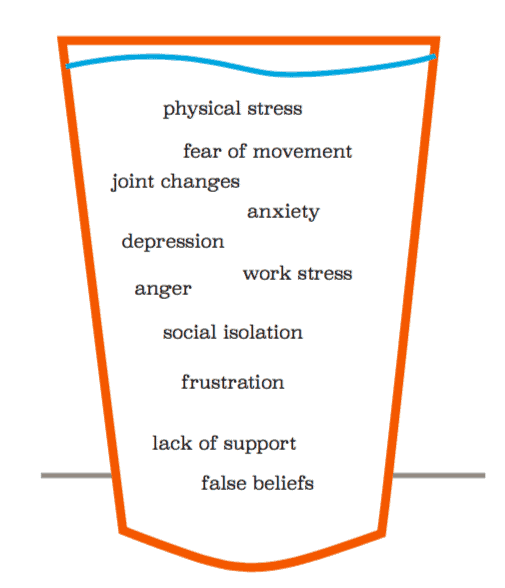
Pain is multifactorial; it is affected by and influences many aspects of your life other than any injury/damage to tissues (muscles, joints, bones, etc) including your work, family and social life, beliefs about pain, etc. This is called the Bio – Psycho – Social model of pain. This may make the situation more complex but it’s a good thing because it means there are a lot of things within your control you can do to influence your pain.
When pain persists it becomes less about damage and more about your sensitivity. A useful analogy is to think of your pain sensitivity like a cup. There are always mechanical, psychological, social and emotional stressors in your cup but if it starts to overflow then your pain may be triggered – “ouch, I tweaked my back!”
How do we keep your pain cup from overflowing?
This can be done by either removing stressors from your cup and/or building a bigger cup. People don’t just decide to run a marathon one day without preparing. They train to develop their ability to handle the stresses of running over time. Similarly, you can increase your resiliency to stress gradually. Fortunately, there are a lot of different ways to make your cup bigger.
- Aerobic exercise. Basically any form of physical activity has been shown to help people with many different types of pain. Go for a walk, bike ride, swim, etc. At least 20 minutes and only moderately intense, you should feel good after this. Even better if you’re outside and go with friends or family.
- Strength and mobility training. Many of my clients benefit significantly from regular strength training two to three times a week which helps them move and feel better, get stronger, improve range of motion, and get more out of the activities they like to do for fun. This is more than just doing planks “because your core is weak and unstable,” a comprehensive strategy to strengthen your whole body and work on your movement limitations, breathing, and mobility/flexibility is more effective and will benefit your health and life in many ways.
- Meditation. Train your mind to be more aware and more capable of handling stress more effectively. My favorite apps are Waking Up and Head Space.
- Improve your sleep. Not only is sleep associated with pain, it’s also vitally important for the health of every system in your body. Ideally, you’re getting 7-9 hours per night and on a consistent schedule – going to bed and waking up at the same time each day. Since sleep behaviors are some of the most difficult to change, one easy thing you can start doing with minimal effort is blocking blue light at night which messes with your circadian rhythm and production of melatonin. Wear blue light blocking glasses during the 2-3 hours prior to sleep, download f.lux on your computer, and make sure Night Shift is set on your iPhone.
- Nutrition. Chronic pain if often linked to chronic inflammation. So what you’re putting in your body can worsen or improve your pain. Without clinging to any specific diet plan, the general approach is to consume more whole foods (pasture raised animal products, vegetables, fruits, nuts, legumes, and good fats like ghee and olive oil) and avoid processed foods (basically anything that comes in a package).
- Do something you enjoy. Remember, social and psychological factors affect your pain. Smiling and doing something fun, especially if it’s with other people, can help improve your pain.
Act now! Don’t let your pain hold you back from living life.
- Make a list of stressors that are in your cup right now.
- Make a list of strategies that you would consider trying.
- Contact Andrew to schedule your complimentary assessment and personal training session.
Credit to Gregory Lehman for these ideas and his fantastic pain workbook. Please see the workbook to learn more about this topic: http://www.greglehman.ca/pain-science-workbooks